
History
![]()
The founder of Operation Bobbi Bear, Jackie Branfield, first took action against sexual crimes in 1992. One day, in a moment of frustration, she demanded to see the reporting docket of an alleged statement made by a four year old girl. The police officer handling the case replied that actually the child did not make the statement, since she was too traumatized to speak and did not know the right words to say, and that the officer, in frustration had written the statement himself, which was “I was raped”. - a statement completely insufficient for a court of law. It was clear to Jackie at that moment, that how an abused child and a police officer talk to each other, can determine the extent to which justice is done.
The problem was largely one of communication. Furthermore, if these barriers were to be overcome, this was often at the expense of the child’s wellbeing. Jackie’s challenge was to ensure accurate information was exchanged and clear legal evidence noted without in any way compromising on the care and support for the victim.
Jackie began a search for toys which would help with this communication and care, and through trial and error, came up with Bobbi Bear’s design, as well as her job description.
![]()
Written by Tania Broughton, 10 July 2002:
She is a maverick crusader, sometimes scorned by those who consider themselves “more professional” or even more spiritual. But Jackie Branfield says she simply doesn’t have time to worry about what other people think of her. And it certainly doesn’t matter to the many abused children and women and people living with AIDS who she has helped over the years. This Amanzimtoti-based activist is something of a contradiction in herself. She feels nothing to fling herself on the floor, adopting either a “gynie” or “bum in the air” pose to illustrate what rape victims, young and old, are subjected to during medical examinations.She tosses around words like semen, vomit and with little thought to the sentiments of her audiences. And yet this woman, without an iota of prissiness, is also a committed Christian with a firm belief that while God can do anything, He sometimes chooses not to. “My job is to do what He asked me to do and that is look after the widows and orphans” she says. And that has involved, at times, taking on those of her own faith. “I couldn’t stand the attitude that HIV/Aids was a disease of sin – we Christians are the biggest NGO in the world and yet most were doing nothing. I would say to them, ‘don’t tell me you care, show me’. “Now they are showing me and for the first time in 10 years, I can say I am proud to be a Christian.” It’s impossible to give Branfield a job designation. In fact, she says she hates it when people ask her, conversationally, what she does, expecting a quick answer. I was soon to learn why.
An interview at her home - on her “day off” - lasts all morning, punctuated with cups of tea, and constant interruptions from the telephone, visitors and her eight-year adopted daughter, Sindi. Sindi has been living with the family - Branfield, her insurance broker husband, Allan and three older children - since she was one month old. Her origins are the one of the few subjects Branfield doesn’t want to put on record to protect her little girl.
About most other things she is shockingly frank, including the fact that she was a victim of abuse herself when she was 10 years old. It is her childhood - and even this horrific incident - which she believes prepared her for what she is doing now. Widowed when her children were young, Branfield’s mother was forced to work days and nights, leaving her to look after her young brothers and other waifs and strays - children from broken or abusive homes - whom she fondly refers to as “pack”. Like a mother lion, Branfield never lost the protective instinct but her pack grew from a few close friends and family, to her immediate community and then beyond. In fact, her most recent case was a “roundabout” referral from England.
It all began 20 years ago at the church youth group when youngsters started approaching her for help with problems. “It was an extremely frustrating experience. I felt that while I was good at talking and listening to them, I couldn’t really help them. I had no education, no training and no money.” She realised she needed to heal, to put her own experience of abuse behind her, something she had attempted to switch off. “I was speaking to God and it came to me, that to forgive was not saying it was okay or that my abuser was right. It was simply a way for me to move on.” And so she did and her “pack” grew and grew and began to include abused women and children from the surrounding townships and even Johannesburg (there’s “pack” there! she explains). Working mainly with her wits in the beginning, she was also picking up facts about HIV/Aids and drugs which could be used to prevent transmission after abuse. Just before the 1994 elections, she was called to the local police station to assist a 19-year-old girl who had been raped.
The same day she saw three little girls, all of whom had been gang-raped. “It was so simple in my mind. I must get the drugs but, of course it wasn’t that simple. I phoned every hospital and pharmacy. I eventually located AZT but then I didn’t have the money. When I got the money (from her brother), I couldn’t find a doctor to administer the drugs and by the time I had found one, the three little girls had been taken to the rural areas and the elder one was in hiding. “I was furious. Why were these victims being treated so badly at police stations and hospitals, why did nobody care, why couldn’t I get the drugs in time?” She started gate-crashing every official meeting she could find on sexual abuse and HIV/AIDs. One of those she met who gave her the time of day, was Liz Towel of home-based care organisation Sino Siso, who trained her to be a HIV/Aids counsellor so she could officially train trainers and counsel children. In the meantime, she was still seeing up to 15 victims of rape a week (”they are not survivors as long as they are in this system”).
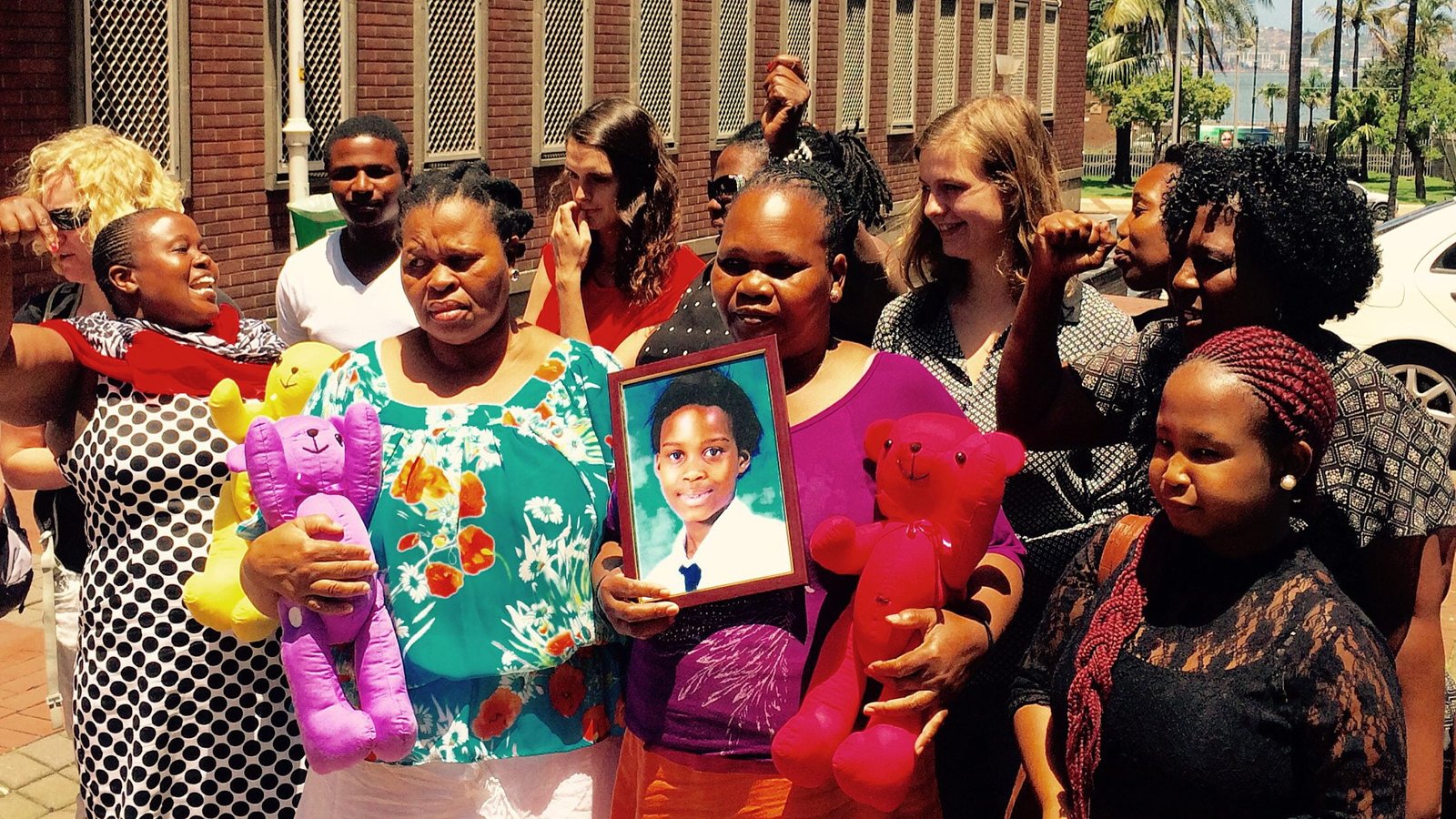
And she was disgusted at what was happening at the police stations and hospitals where victims - often small children - would sit for hours, without a kind word, let alone professional help. As angry as she was, she realised the police and health care workers were swamped, inadequately trained and simply did not know what to do. So the Bobbi Bear Foundation was born. In the kits which Branfield and her volunteers carry around with them are the essentials for victims of rape. In the kiddie kit, there is a small pair of panties or underpants, a sanitary pad, sweets and a cold drink, gloves, notebook pen and marker and Bobbi Bear. The child uses the bear to point out where he or she has been hurt and the areas are marked on to the bear with the marker pen. The children are encouraged to draw and often they will draw something related to the abuse. This is all given to the investigating officer to assist with the formal police investigation.
There’s another kit of adults and a kit for children who need to be removed and placed into care. Her other “baby” is her work with children affected HIV/AIDS, educating communities, assisting those living with the virus and others dying from the disease.
Part of this is an educational programme she runs with her “Aids toys”- cut-out pieces of foam and puppets masquerading as urine, spit, vomit, blood tears and saliva, bad germs and antibodies - to show how the disease spreads through the body and teach infection control to small children. The programme also assists in identifying possible sexual abuse, without words such as sex, vagina and semen ever being used. She knows she is showing and telling people more than they want to know - but getting the message across in the most effective way is all that matters. She gets up to demonstrate her gum boot dance, ably assisted by Sindi, them repetitive message being “if its wet and from the body, don’t touch it”. Although she receives donations, she still has no regular funding “which means I don’t belong to any old boys clubs”. “But I have proved that you don’t need money or degrees to care about children - and I know one person can make a difference.


